
Media Buying Beyond Google, Meta and TikTok: Where Else to Buy Ads

Online advertising is bigger than Google, Snapchat and TikTok
Ask any business owner where they advertise and you will hear the same four or five names
Those are big, real places and we buy in them every week. They are not the whole internet
Your customer may read a newsletter about their profession every morning, follow a niche site in their industry, and ask colleagues in a Telegram channel before they buy. All of these places sell ads, and none of them show up in any ads dashboard you open
This guide covers where ads are sold outside the big platforms, how to find out where your customer actually is, and how to work out what a placement is worth before you pay for it
Khaled, who sells clinic booking software, is an illustrative character from the ehaplil guide series and his numbers are close to market. Public figures are published, with sources linked in the text
Is online advertising just Google, Meta, Snapchat and TikTok?
No, but it is easy to think so, because that is where most of the money goes
According to WARC, Alphabet (Google and YouTube), Meta and Amazon took 56.1% of global ad spend outside China in 2025, about 556.6 billion dollars, and their share is expected to reach 58% in 2026
Three companies' share of the ad market
Outside China, WARC forecast, December 2025
More than 40% of the market still sits elsewhere: news sites and magazines, newsletters, apps, podcasts, online stores and comparison sites
Yet most marketers start with the same four platforms and stop there. There is a reason for that
Why do Google and Meta teach advertising for free?
Google offers professional certificates, including one in digital marketing and e-commerce, and more than 1 million people have graduated from them worldwide according to Google's 2025 report
In the Middle East, Google said in 2021 that about 1 million Arabic speakers had completed its Maharat min Google program. Meta has Blueprint (Meta's official ads training) and TikTok has a similar academy
These are useful programs and we do not tell anyone to skip them
But each one teaches its own company's tools, with examples from its own campaigns, and measures your success with its own dashboard. You will not find a lesson on buying a slot in a niche newsletter or negotiating with an industry site, because that is not the job of the company training you
What does the Google Partner badge require?
To earn the Google Partner badge, at least 50% of an agency's account strategists must hold Google Ads certifications
The agency must also manage at least 10,000 dollars of spend on Google every 90 days and keep its Optimization Score (Google Ads optimization score) above 70%, a score that rises when you apply or dismiss Google's recommendations
From Google's side this makes perfect sense, and Microsoft and Cisco did the same with software and networking certifications long before. People who learn on your tool come back to it, and people who carry your badge keep their spend with you
For the business owner, the result is that the marketer they hire usually asks which campaign type to use before asking where the customer reads
A marketer trained on a platform knows how to buy inside it. Media buying as a profession means knowing where the audience is, who sells access to it, and what that access is worth
What is media buying?
Media buying is buying the ad space where your audience will see your message, at the best price you can get, and then tracking what comes from it
A media buyer is the person who does this and decides where to spend, how much, and when to stop
Some buying happens in self-serve auction accounts like Google and Meta, some through direct deals with publishers like newsletters and niche sites, and some through intermediary platforms like programmatic
Media planning is the step before it: deciding where to appear, for whom, and with what budget, before you buy anything
Marketing vs promotion vs advertising vs sales
People use these four words as if they were one, and that confusion makes business owners ask advertising to do things it cannot do
| Term | What it means | How you measure it |
|---|---|---|
| Marketing | Choosing the customer, what you offer, the price, and where they find you | Market share, margin per sale, customer growth |
| Promotion | Everything that makes customers know and remember you: ads, sponsorship, PR | How many people know your name and recall it when they need it |
| Advertising | Space you pay for so your message appears | Cost of the extra customer against what your business can afford |
| Sales | Turning an interested person into a paying customer | Close rate, response time, deal value |
Promotion is one of the four elements of the 4Ps (the marketing mix: product, price, place and promotion), and advertising is one method inside promotion
So when sales do not come, the cause may be a price that does not fit, as we covered in the pricing guide, a sales team that replies two days later, or a product that does not convince in the trial
Good advertising brings the right person to your door. What happens after the door is not its job
The first part is set by the market and no ad changes it. The last part is set by your product, price and sales. Advertising works on the middle part: getting more of the right people to know you at the right time
How do you know your customer before you buy ads?
This is the hardest part of buying, even though it looks like the easiest
Every business owner says they know their customer, then describes them in ads-dashboard language: aged 25 to 45, lives in Riyadh, interested in tech
Facebook understands that description. It tells you nothing about where this person reads while thinking about work, or who they ask before paying
We will follow one example to the end of the guide: Khaled, who sells clinic booking software at 80 dollars a month
In the ad economics guide we worked out that he pays 300 dollars in ads for each new clinic and can afford at most 310. He is right at the limit, and any increase in his Google budget pushes him over it
Who makes the buying decision?
In a small clinic the doctor uses the software, the clinic manager picks it, and the owner pays
Sometimes all three are one person, usually they are not, and each reads in a different place and cares about something different
Ask the people who paid you
The best source on your customer is a customer who paid you recently, because they went through the decision and still remember it
Call ten of them for fifteen minutes each. Do not send a survey: a survey gives you tidy answers, a call gives you the story
We ask these questions in this order
- What happened before you started looking for a solution? This tells you the event that puts a customer in the market
- What did you type first, and where?
- Who did you ask before deciding?
- What do you read, listen to or follow for work? This one question reveals most of the places you do not know about
- What were the other options, and why did you choose us?
- What almost stopped you? This is usually your next ad message
Here is what Khaled got from ten calls
| Answer | Clinics |
|---|---|
| The decision started with a crisis, like a receptionist quitting or lost bookings | 6 |
| Reads a weekly newsletter about running clinics | 6 |
| Almost stopped by fear of moving patient data | 5 |
| Started searching on Google | 4 |
| Asked a colleague in a doctors’ Telegram or WhatsApp group | 3 |
| Compared tools on a site like Capterra | 3 |
| Heard about the software from the medical equipment supplier’s rep | 2 |
Ten calls are not statistical research and you should not treat them as such
But they showed Khaled two places that were not in his plan at all, the newsletter and the comparison site, and a message he had never written in any ad: patient data safety
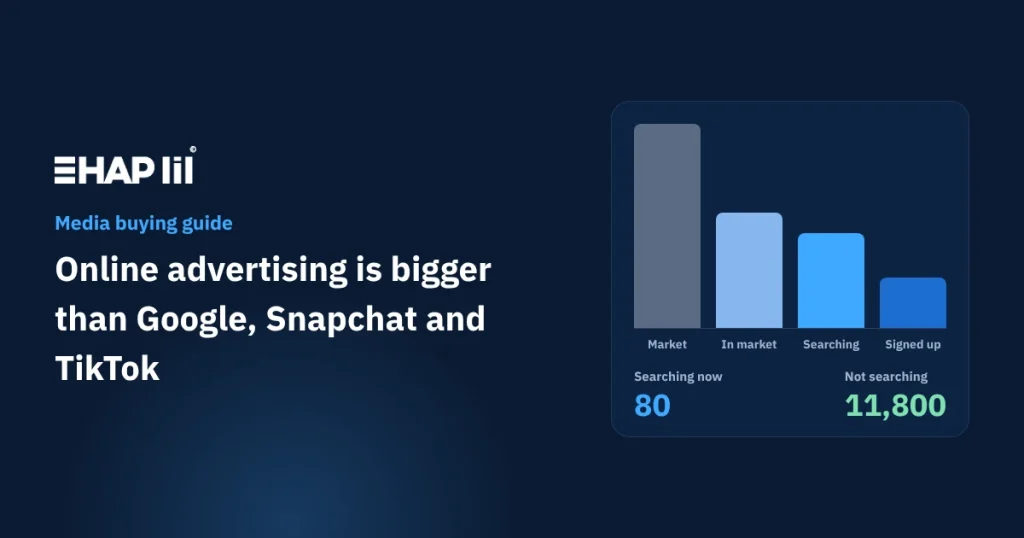
How many customers are looking for a solution this month?
Most of your potential customers are not ready to buy now. They are happy with what they have and will not switch until something happens
John Dawes of the Ehrenberg-Bass Institute explained it with a simple example: if companies switch providers about every five years, around 20% will buy within a year, and only about 5% are in the market at any moment
Khaled estimated his market at about 12,000 small clinics, and a clinic switches booking software about every 5 years. So only 200 clinics look for new software each month
From the calls he knew 4 in 10 start on Google, about 80 clinics a month
From 12,000 clinics to 10 paying clinics
Khaled's market in one month, on a log scale so the small numbers show
Khaled gets 10 of those 80
When he raised his Google budget by 1,100 dollars, no new searchers appeared. He paid more in the auction for the same 80 against the same competitors, and the extra click went from 2 to 2.75 dollars
Search ads have a ceiling, and the ceiling is the number of people searching, not the size of your budget
Meanwhile 11,800 clinics are not looking now and will look over the coming years. When their decision day comes, they will usually start with names they already know
According to Gartner, B2B buyers spend only 17% of their buying time with all suppliers combined, and most of the rest reading, asking and comparing on their own
Reaching those clinics before their decision day is what you buy in newsletters and niche sites
How many customers are in your market this month?
The numbers are Khaled's. Type yours
There is room in search: 70 search and do not choose you. Before more budget, review the message and landing page, then reach those not in market
Types of advertising outside the big platforms
These are the placements a professional media buyer works with. Each has its own way of buying, its own pricing and its own traps
Not all of them will fit you. What matters is knowing they exist before you decide
Other auction platforms
LinkedIn, X, Reddit and Pinterest, plus Snapchat, whose ads reach 72.9% of Saudi Arabia's population according to DataReportal but only 17.3% of Egypt's
You buy the same way as on Meta, from a self-serve account with a daily budget
LinkedIn clicks cost much more, but it is almost the only place where you can target by job title and company size, which matters when your customer is a procurement manager
Programmatic advertising
Here you buy space across thousands of sites and apps at once through a DSP (demand-side platform the advertiser buys from) such as Google Display & Video 360 or The Trade Desk
You can buy in the open auction, in a Private Marketplace with selected publishers at higher quality, or through Programmatic Guaranteed deals with an agreed volume and price
This is where you need to be very careful
In the 2023 ANA study of 123 million dollars spent by 21 brands, only 36% of the money reached the intended audience, 29% went to fees for the tech companies in the middle, and 15% went to sites made only to show ads
In the 2024 report the share rose to 43.9% when advertisers cut the number of sites they appeared on from 44,000 to 22,634
That is why, when we buy programmatically, we start from a list of sites we know and review, and never let the platform pick from the whole internet
Native advertising
The boxes under news articles labeled "you may also like". The best-known sellers are Taboola and Outbrain
You usually pay per click, reach is large and prices are low, but visitor quality varies a lot from site to site
It suits content that explains and persuades more than a direct sales page, and you should review the list of sites you appeared on every week and exclude the bad ones
Amazon and noon ads
Someone typing "oud perfume" inside Amazon or noon wants to buy now, not browse, and the store sells you the top of its search results
noon offers this to sellers through noon Ads and Amazon through Sponsored Products. This kind of retail media is close to 14.7% of global ad spend according to WARC
It suits anyone selling inside these stores. You pay per click, and measurement is easier than any other channel because the sale happens in the same place
Newsletter advertising
People subscribe to a niche newsletter themselves to read about their profession or interest. You can buy a slot in one issue, a whole dedicated issue, or a short line in the classifieds section
According to beehiiv, cost per thousand subscribers runs from 15 to 35 dollars for general newsletters and from 50 to 100 dollars and up for niche and B2B newsletters
Small newsletters under 5,000 subscribers usually sell an issue for 50 to 250 dollars. These are mainly US market figures. Niche Arabic newsletters are fewer and their prices are set by negotiation
A newsletter's value is attention and trust: the reader chose it, opens it at a quiet moment, and trusts the person who writes it
Niche sites and trade publications
Every industry has a news site, a professional association, a magazine and an annual event, and most of them sell ads directly without any auction
It might be a fixed slot for a month, a sponsored section, or a sponsored article. Ask first for their Media Kit (a document where the publisher shows its audience and prices), then negotiate
The audience is smaller, but it is usually the audience you cannot find precisely on any platform
Comparison sites and directories
Someone comparing suppliers in a directory is usually very close to a decision
In software, Capterra sells the top of each category list per click, starting at 2 dollars, and you bid on the category rather than the keyword
Services have similar directories, and e-commerce has service-provider directories inside the store platforms themselves, like Shopify's Partner Directory or Salla's merchant services in Saudi Arabia
Podcast advertising
An ad read by the host at the start or middle of an episode, or a sponsorship of an episode or a whole season
According to AdResults Media, the average US cost per thousand listens is about 20 dollars for a pre-roll and 25 for a mid-roll, and host-read ads cost more
In the Middle East, platforms like Anghami sell audio ads inside their streams. Measurement is hard here, so rely on a unique code and a short, memorable link
Telegram ads and communities
Telegram has an official ad platform, Telegram Ads, which shows short messages inside large public channels. Next to it sits a much bigger market: direct deals with channel owners for a sponsored post
WhatsApp channels, Reddit and Discord communities and professional forums are similar. Some accept ads and some refuse them entirely
Be careful here. A group whose members trust it loses that trust when it fills with ads, and the better move is usually agreeing with the owner on useful content under your name
Niche creators
This means the small creator specialized in your field, like a doctor explaining clinic management on YouTube or a perfume reviewer whose audience trusts their opinion
In the ad economics guide the celebrity cost the perfume store 25 dollars per order, while a niche reviewer brought 22 orders for 300 dollars, 13.64 per order, below the store's limit
Partners and commission
A person or company that sells something else to the same customer and earns a commission for every customer they send you who pays
For Khaled it is the medical equipment supplier's rep, who visits clinics anyway. The advantage is that you pay after the result, not before
| Placement type | How you buy | Usual pricing | Best for |
|---|---|---|---|
| Other auction platforms | Self-serve account | CPM or CPC | Large audiences or targeting by job title |
| Programmatic | DSP, open auction or private deal | CPM | Broad reach with a defined site list |
| Native | Network account | CPC | Content that explains and persuades |
| Amazon and noon | Seller account | CPC | Products sold in the store |
| Newsletters | Direct deal with the publisher | Flat fee per issue | Narrow, well-defined audiences |
| Niche sites | Direct deal or private programmatic deal | Flat fee or CPM | Professions and industries |
| Comparison sites | Vendor account on the site | CPC per category | Software and services |
| Podcasts | Direct deal or audio network | CPM or flat sponsorship | Anything that needs the host’s trust |
| Telegram and communities | Telegram Ads or the channel owner | CPM or flat fee per post | Fields with active communities |
| Creators | Direct deal | Flat fee or commission | Products that need a demo or explanation |
| Partners | Commission agreement | CPA | Anyone selling a complementary product to the same customer |
How do you compare different ad prices?
Every place sells to you differently, which is what makes comparison hard
Google sells the click, a newsletter sells the issue, a podcast sells a thousand listens and a partner sells the customer. Comparing a click price with an issue price compares two different things
| Model | You pay for | Who carries the risk? |
|---|---|---|
| CPM (cost per thousand impressions) | Every thousand times the ad shows | You, entirely |
| CPC | Every click | You, but at least the click happened |
| Flat fee or sponsorship | Space for a set period or issue | You, which is why you calculate before paying |
| CPA or commission | Every customer or sale | The publisher or partner |
The only way to compare is to turn everything into one number, what you paid for each customer who paid you, and compare it with the most your business can afford per customer, 310 dollars for Khaled
Here is Khaled's comparison for one month
| Placement | Paid | From view to payment | Cost per click | Cost per clinic |
|---|---|---|---|---|
| More Google Ads budget | $1,100 | 400 clicks, 24 trials, 2.7 clinics | $2.75 | $412 |
| Clinic management newsletter, two issues | $1,100 | 8,000 reads, 160 clicks, 24 trials, 4 clinics | $6.88 | $275 |
| Equipment supplier commission | $450 | 3 paying clinics at 150 dollars each | None | $150 |
Cost of the extra clinic from each placement
In dollars. The dashed line is the most Khaled can afford
Look at the cost per click column
A newsletter click cost more than twice a Google click, and anyone judging by that number alone would kill the newsletter immediately
But the number of trials was the same, 24, and the difference came after the trial. The people who clicked in the newsletter were mostly clinic owners or managers, so half of them used the software instead of 40%, and a third of those paid
Still, two issues of one newsletter are not a final verdict. The gap between 4 clinics and 2 could be chance, so Khaled treats these numbers as a reason for a third and fourth test, not as a fact to build the year's budget on
How do you vet a placement before paying?
On the big platforms you do not have to trust anyone. The platform shows you the numbers and charges after the impression
In direct buying you usually pay before you see anything, so vetting before you pay is the most important part of the job
What to ask the publisher for
- The real subscriber or visitor count from its source, such as the newsletter platform dashboard or Google Analytics
- Open rate or listen-through for the last three months, not the best month
- Click rate on previous ads and the names of past advertisers, so you can ask one of them how it went
- Who the readers are by profession, country and company size where possible
- Three past issues or episodes you read yourself
Red flags
- A bought or scraped email list. That is not an audience, and mailing it hurts your sender reputation and breaks data protection law in most countries
- A strangely high open rate with very few clicks, usually email security scanners rather than people
- Refusing to share any numbers before payment
- In programmatic, sites you do not recognize with copied content and almost nothing but ads
Work out your maximum price before you hear theirs
The riskiest moment in direct buying is when the publisher names a number before you know yours, so the negotiation starts from their number
For Khaled, 4,000 of 8,000 subscribers read the newsletter, 2% of them click (80), 15% of those try it (12), and a sixth of those pay: 2 clinics
Two clinics at 310 dollars means a maximum of 620 dollars per issue. The publisher asked for 550, under the limit by a small margin, so Khaled bought two issues to test instead of booking three months
That works out to about 69 dollars per thousand subscribers, within the range beehiiv gives for niche newsletters
Is the placement worth its price?
Works for any flat-fee placement: newsletter, site, podcast or channel. The numbers are one issue of Khaled's newsletter
The price is under your limit but the margin is thin. Any error in your rates turns it into a loss. Negotiate a lower price or a smaller slot
If you do not know your rates yet, start with your current ad rates and correct them after the first test. Khaled's paying rate is 16.67% because half of trials use the software and a third of those pay
How do you negotiate with a publisher?
Direct buying is closer to buying any service than to launching a campaign: an offer, a negotiation, a written agreement, delivery and a report
The listed price is not the final price
Most publishers have a Rate Card and most will negotiate on it, especially small publishers who do not sell all their inventory
You can ask for a lower price for booking several issues, an extra free placement, or a better position in the newsletter
Always ask about the cheaper slots. A short line at the bottom of a newsletter may cost a quarter of the main ad and is enough for a first test
What should be in writing
A short agreement, usually called an Insertion Order (the order between advertiser and publisher), even if it is an email both sides approve
- The publication date and exact placement
- What will appear, who writes it, and the content deadline
- The report the publisher will send afterward and the numbers in it
- What happens if the agreed delivery is missed, such as a free make-good placement
- Payment date and cancellation terms
Write the ad in the placement's language
An ad in a newsletter a clinic manager reads in the morning is nothing like a TikTok video
Write it the way the newsletter's author writes: one sentence on the problem, one on the solution, and one link to a page written for this specific reader
Khaled's first sentence was about the fear of moving patient data, because that is what almost stopped five clinics out of ten
If you work with an agency
Ask the agency plainly how it makes money on the buy: a percentage of spend, a flat fee, or rebates from publishers that you never see
Ask for invoices and reports from the publisher itself. Large companies do this with their agencies, and it is part of why the ANA study exists
How do you measure an ad with no dashboard?
The main reason companies stay on the big platforms is that the platforms measure themselves. You open the dashboard and the numbers are there
A newsletter or site has no dashboard, so you build the measurement before publishing or you learn nothing afterward
And do not assume a platform dashboard is neutral. In the ad economics guide, Snapchat and TikTok claimed 142 orders while the store recorded only 120
| Method | What it catches | What it misses |
|---|---|---|
| A link with UTM (tags that tell Google Analytics the source) | People who clicked and signed up on the same device | People who remembered your name and searched days later |
| A discount or gift code unique to the placement | People who bought weeks later with the code | People who forgot the code |
| A landing page unique to the placement | Everyone who came through it | People who came through the homepage |
| A free-text “how did you hear about us?” question | The newsletter, the colleague, the supplier, the podcast | People who do not remember exactly |
| Branded searches and direct visits, before and after | People who saw the ad but did not click | Seasonality, so compare with the same period last year |
Khaled used the link, the code and the question together, and waited 30 days after each issue before judging, because a clinic manager reads today and decides two weeks later
Of the four clinics, 2 came through the link, 1 with the code, and 1 wrote "the newsletter" in the how-did-you-hear field with no link or code
Had he relied on the link alone, he would have priced each clinic at 550 dollars and stopped the newsletter
In our marketing attribution case study we found that 52.3% of a subscription company's records had no recorded source before we connected the data. When half the picture is missing, decisions drift toward the channels that measure themselves
How do you split the budget?
Khaled did not stop Google Ads. It works under the limit and there is no reason to stop it
What changed is where the increase went: to where the extra clinic is cheaper, and to the clinics that are not searching today. How big the budget should be, and when to raise or cut it as sales change, is in our marketing budget guide
| Khaled’s plan for next month | Pays | Expected clinics | Cost per clinic |
|---|---|---|---|
| Google Ads at the same budget | $3,000 | 10 | $300 |
| Clinic management newsletter, two issues | $1,100 | 4 | $275 |
| Equipment supplier commission | $450 | 3 | $150 |
| Total | $4,550 | 17 | $268 |
Had he put the whole increase into Google, he would have paid 4,100 dollars for about 12.7 clinics, 324 per clinic, over his limit
With the split he gets 17 clinics at 268 each, and Google's share of new clinics drops from 100% to 59%
Why does it matter not to depend on one place?
When more than 70% of your new customers come from one place, your business depends on a decision you do not own: auction prices rising in a season, an algorithm change, or an account suspended by mistake
We treat that share as a warning, not a scientific number, but it reminds you that testing a new place is far cheaper than the first crisis in your only place
What does research say about balance?
Research by Les Binet and Peter Field on 996 campaigns in the IPA databank found the best average balance was about 60% for reaching people not yet in market and 40% for capturing those searching now
The split varies by category, but Khaled's math explains the idea: the 80 clinics searching today learned competitors' names a year ago, and the clinics searching next year are learning names now
What about a store or a service business?
Same questions, different answers
The perfume store from the ad economics guide has customers in market almost all the time and heavily present on Snapchat and TikTok, so those stayed its main channels. It added ads inside noon, niche perfume reviewers, and corporate gift orders before Eid
The design and marketing agency that serves new store owners found its customers ask their accountants and store developers before choosing, so it agreed with two partners on 250 dollars per signed client, instead of 750 dollars in ads it used to pay per Google client before knowing the result
Checklist before any buy
- Do you know the most you can afford per customer? This is the number you judge every placement by. Work it out in the ad economics guide
- Have you called ten customers who paid you? And asked what they read and who they ask
- Do you know how many customers are searching this month? And your share of them
- Did you work out the maximum price before hearing theirs?
- Did you see the publisher's numbers at the source? And read three past issues
- Is the agreement in writing? Date, placement, content, report, make-good and payment
- Are the link, code and how-did-you-hear question ready? Before publishing, not after
- Do you know when you will judge it, and on which number?
Customer channel map on Google Sheets
Everything in this guide in one file with Khaled's numbers. Clear them and type yours
Copy the file from File, then Make a copy, and type only in the blue cells
Customer channel map
For stores, services and SaaS
- Customer call questions and a counter for places that repeat
- How many customers are searching this month
- A score for every placement before you buy
- Maximum price calculator for newsletters and sites
- Placements compared by customer cost
- Test plan, monthly log and dependence on a single channel
FAQ
What is media buying?
Media buying is buying the ad space where your audience will see your message at the best price you can get, then tracking what comes from it, whether through a self-serve platform account, a direct deal with a publisher, or a programmatic platform
What is the difference between a media buyer and a media planner?
A media planner decides where the ad appears, for whom and with what budget, and a media buyer executes the purchase, negotiates, tracks results and decides when to scale up or stop. In small companies one person usually does both
Is online advertising only Google, Facebook, Snapchat and TikTok?
No. These are the largest, and Alphabet, Meta and Amazon took 56.1% of ad spend outside China in 2025 according to WARC, but ads are also sold in newsletters, niche sites, Amazon and noon, podcasts, Telegram, comparison sites, programmatic exchanges and through partners
What are the types of digital advertising?
Auction platforms such as Google, Meta, Snapchat, TikTok and LinkedIn, programmatic buying through a DSP, native networks such as Taboola and Outbrain, retail media such as Amazon and noon, newsletters, niche sites, comparison sites, podcasts, Telegram and communities, creators, and commission partners
What is the difference between marketing, promotion, advertising and sales?
Marketing is choosing the customer, product, price and place, promotion is everything that makes customers know and remember you, advertising is paid space inside promotion, and sales is turning an interested person into a paying customer
Why do Google and Meta offer free marketing certificates?
Because people who learn advertising on a tool come back to it when they advertise, and agencies need Google certifications and at least 10,000 dollars of spend every 90 days to earn the Google Partner badge. The programs are useful, but they teach success inside one platform
How do I find out where my customers are?
Call ten customers who paid you recently and ask what happened before they started looking, what they typed and where, who they asked, and what they read for work, then look for the places that repeat in their answers
Why does my cost per click rise when I increase my Google budget?
Because the number of people searching each month is roughly fixed, so the extra budget finds no new searchers and pays more in the auction for the same people against the same competitors
How much does newsletter advertising cost?
According to beehiiv, cost per thousand subscribers runs from 15 to 35 dollars for general newsletters and from 50 to 100 dollars and up for niche and B2B newsletters, and newsletters under 5,000 subscribers usually sell an issue for 50 to 250 dollars
How do I calculate the maximum price for a newsletter or niche site ad?
Multiply the people who see the ad by the click rate, trial rate and paying rate, then by the most you can afford per customer. The result is the most you should pay for the placement
What is programmatic advertising, and is it safe?
It is buying space across many sites and apps through a DSP, in auctions or private deals with publishers. In the 2023 ANA study only 36% of spend reached the intended audience, so do not buy programmatic without a defined list of sites you know
How do I advertise on Telegram?
Either through the official Telegram Ads platform, which shows short messages inside large public channels, or through a direct deal with the owner of a niche channel for a sponsored post. Either way, use a unique link and code to know what came from each channel
How do I measure an ad in a newsletter or site that has no ads dashboard?
Use a UTM-tagged link, a code unique to the placement and a free-text how-did-you-hear question, wait 30 days before judging, and watch branded searches against the same period last year
Should I stop Facebook and Google ads?
Not if the cost per customer from them is below what your business can afford. The more important question is where the extra budget goes, and if more than 70% of new customers come from one place, it is time to test another
Before you raise your ad budget, know where the increase will go
By your numbers you take 12.5% of this month's searchers, so there is room in search, and there are also 11,800 customers not searching now that search ads never reach
In one 60-minute session we review your numbers with you and leave with three things in writing
- The places your customer reads and where to start
- The most you should pay for each placement before you negotiate
- A test plan for the first 30 days and how to measure it
Ehap Lil
I help companies reach clear, predictable financial growth by tying marketing effort to financial results, and by fixing the decisions that hold back returns or make sales swing
In this article
Table of contents
Read next
Marketing Budget: How Much to Spend, and Should You Spend More When Sales Drop?

Ad costs: how to calculate ROAS and the maximum cost per order and customer
Pricing and Unit Economics: A Practical Guide for Stores, Services and SaaS
Collections, sales and financing are not separate islands

When should a startup hire a new employee?
