
Pricing and Unit Economics: A Practical Guide for Stores, Services and SaaS

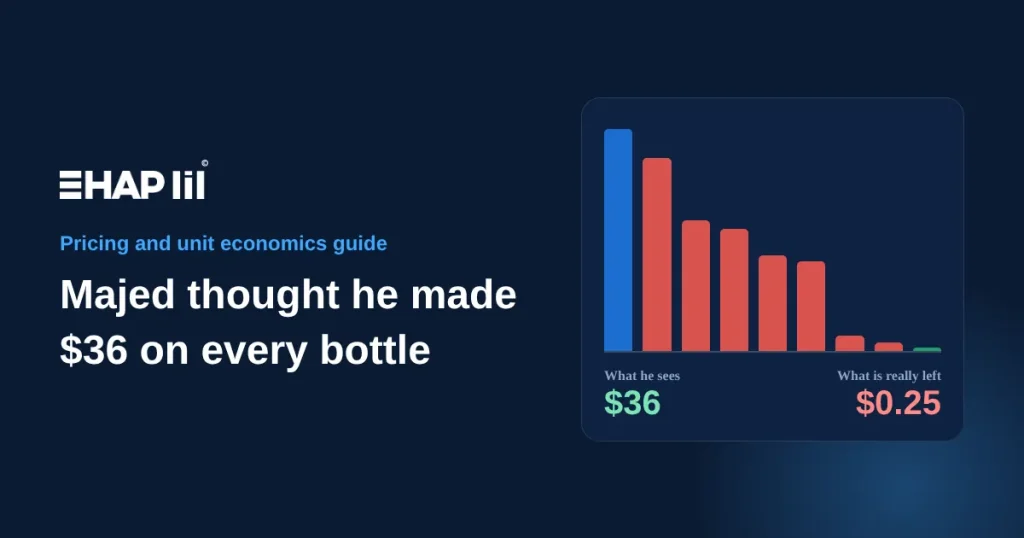
Majed thought he made $36 on every bottle
Majed sells perfume through an online store in Saudi Arabia. A bottle sells for $50 and costs him $14 from the factory
His math is simple: 50 minus 14 is $36 profit on every bottle
At the end of the month he sold 120 bottles, opened his bank account and did not find the profit he expected. He found he was paying out of his own pocket
In this guide we follow Majed’s bottle dollar by dollar, then apply the same method to service companies and subscription companies, with real examples from well known companies and calculators you can try on your own numbers
Majed, Sara and Khaled are illustrative characters with costs close to market prices. Zara, Costco, MoviePass and Dropbox numbers are real, from their published results
Where did Majed’s profit go?
We start from the $50 the customer pays and see where each part goes
The customer pays $50 for the bottle
$50.0015% VAT is part of the price, but it is not Majed’s money, it belongs to the government
−6.52The perfume itself from the factory, the only number Majed was counting
−14.00Box and packaging carton, paper, tape and a thank you card
−2.00Shipping carriers sell stores bundles at roughly 20 to 30 riyals per parcel
−6.00Payment fees mada, cards and the gateway, about 2% plus one riyal per transaction
−1.27Ads he spends $1,800 a month on Snapchat and TikTok, and 108 orders reached customers
−16.67Returned orders 1 in 10 orders is refused at the door or returned, and Majed pays shipping both ways
−1.56The influencer code 4 in 10 customers used a 10% coupon
−1.74What Majed keeps from the bottle
$0.25The perfume bottle waterfall
Click each case to see the gap between what Majed sees and what actually happens
From 108 orders Majed kept only $27, and every month he has $800 in fixed costs: the store platform, software, a small storage room and product photos
So he lost $773, while believing all month that he was making money
Majed does not have a sales problem. He has a problem where almost every sale leaves him nothing
To cover his monthly costs with the same numbers he would need 3,241 orders a month, 30 times what he sells now. More ads will not get him there, because every new order leaves the same 25 cents
What did Majed not count?
Majed is not an exception. Most business owners count the same way, because they mix up three different things
Costs that repeat with every sale
Every time you sell a bottle you pay them again: the perfume, the box, shipping, payment fees, ads, returns and discounts
Costs you pay every month
You pay them whether you sell one bottle or a thousand: rent, salaries, the platform and software
What is left from a sale
The selling price after all the costs that repeat with the sale. This is called contribution margin
Contribution margin is what you keep from one sale after all its costs. It is called that because it contributes first to paying the monthly costs, and whatever is left after that is profit
The whole idea in one sentence: what is left from each sale, multiplied by the number of sales, has to cover the monthly costs first. Whatever is left after that is your profit
Breakeven is the number of sales you need each month to avoid a loss. For Majed: 800 divided by 0.247, about 3,241 orders, because each bottle leaves exactly 24.7 cents
A mistake everyone makes: 50% is not 50%
You buy a product for $100 and sell it for $150
You say “I make 50%” because you added 50% on top of cost. That is called markup
But the money that comes in is 150, and the difference is 50 of it, only 33% of the selling price. That is your margin
The gap between the two numbers looks small, but it disappears from your books every month if you build your plan on the bigger number
| If you add on cost | Your real margin on price |
|---|---|
| 25% | 20% |
| 50% | 33.3% |
| 100% | 50% |
| 200% | 66.7% |
And VAT is not your income
VAT is 15% in Saudi Arabia and 14% in Egypt
If your price includes VAT, then out of every 115 the customer pays you keep only 100 before any cost. Forget this and you calculate your profit on money that is not yours
What can Majed change?
The good news is that Majed does not need a miracle. He needs to fix one sale before he looks for more sales
We tried each change on its own, with everything else the same. This is what he keeps from a bottle after each change:
| The change | Kept per bottle | What it means in practice |
|---|---|---|
| Nothing, today | $0.25 | Almost every sale is worth nothing |
| Stop coupon codes | $1.99 | Pay influencers a commission instead of a customer discount |
| Cut returns from 10% to 5% | $1.94 | A confirmation message before shipping, and nudging prepayment |
| Cheaper shipping ($4 instead of $6) | $2.69 | A bigger shipping bundle or another carrier |
| Customers buy again | $4.10 | If 3 in 10 customers buy a second time without a new ad |
| Ad cost per order 25% lower | $4.41 | Stop the ads that do not sell |
| Raise the price to $60 | $8.39 | The biggest effect by far |
| Price $60 + no coupons + 5% returns + ads 25% cheaper | $16.12 | Needs only 50 orders to cover monthly costs |
What is kept per bottle after each change
In dollars, from a $50 price (and $60 in the last two rows)
Notice that raising the price by just $10 multiplied what is left more than 30 times, because the whole increase goes to the small part that was left
With the four changes together, Majed keeps about $1,038 profit a month from roughly the same number of orders, instead of losing $773
Will sales drop if he raises the price? Maybe, but Majed now needs only 50 orders to cover the month instead of 3,241. Even if orders fell by half he would still make money
Calculate your product waterfall
Enter the numbers for one product in your store. The calculator draws the waterfall, tells you what you keep per order, and how many orders a month you need to avoid a loss
The numbers now are Majed’s
Your product waterfall
Enter the price the customer pays including VAT
Stores: you pay for goods before you sell them
In retail two questions rule everything: what each item leaves, and how long it sits on the shelf before it sells
Zara: from 58 to 15
Inditex, the company that owns Zara, sold about €39.9 billion in its 2025 fiscal year
After the cost of the clothes themselves, 58.3% of sales was left. Out of every €100 you pay in the store, the item costs about €42
If the math stopped there we would say Zara makes €58 out of every €100. But its net profit at the end of the year was €6.2 billion, about €15.6 out of every €100
Out of every €100 of Zara sales
Fiscal year 2025, from the company’s published results
Where did the difference go? Store rent, staff salaries, shipping, marketing, taxes and everything a store needs to sell
The same thing that happened to Majed, at a much bigger scale
If Zara, with all its size and brand strength, keeps less than a third of the gap between cost and price, do not build your plan on that gap
Costco: sell on a thin margin, profit from somewhere else
Costco is one of the largest retail chains in the US, and its pricing works the opposite way to Zara
In its 2026 fiscal year it sold about $297 billion, and the gap between selling price and cost of goods was only about 11%
So how does it make money? Only people who pay a yearly membership can shop there. Membership fees alone were $5.9 billion, and total net profit was $9.2 billion
A thin margin is not a problem when goods sell very fast and another source covers the costs
The trouble starts when a small store owner sells on a Costco margin, without Costco’s sales volume and without a membership to cover the gap
Turnover speed: why a corner store lives on a thin margin
A carton of 40 small water bottles sells in large Saudi supermarkets for about 15.5 riyals, under 40 halalas a bottle
The profit on one bottle is tiny, but water never stays on the shelf more than a few days
Compare two products in the same store:
20% margin
All the stock sells and renews about every two days, 182 times a year
Each dollar in its stock returns about $45 of profit a year
60% margin
It sits on the shelf two months before it sells, so it renews 6 times a year
Each dollar in its stock returns about $9 of profit a year
The product with the bigger margin made five times less, because the money you paid for it was asleep on the shelf
So do not judge a product by its margin alone. Judge it by margin and selling speed together
The product that brings the customer in
A corner store does not make much on water, but the customer who walks in for water also buys bread, milk and snacks
Some products exist to bring the customer in, not to make money. What matters in retail is the profit of the whole basket, not of each product on its own

Physical store and online store: same goods, different costs
In a physical store
Rent is the heaviest fixed cost, so space itself has a price. A shelf holding a slow product pays the same rent as a shelf holding a product that sells every two days
Some costs never appear on an invoice: damaged, expired and missing goods, and dead stock you sell at a big discount at the end of the season
In an online store
There is no shop rent, but many costs that were fixed become costs that repeat with every order: shipping, payment fees, packaging, ads and returns
That is why average order value matters so much. $6 shipping takes 30% of a $20 order and only 7.5% of an $80 order
Cash on delivery
Cash on delivery is less common in Saudi Arabia than in the rest of the region, but it is still there, and market estimates put the share of orders refused at the door or returned between 8% and 15%
Every returned order means you paid shipping twice and paid for the ad that brought the customer, and sold nothing
Simple ways to reduce this: a confirmation message before shipping, a small discount for prepayment instead of a general discount, and a small fee for cash on delivery
Payment fees
mada fees in Saudi Arabia are roughly 0.8% to 1.5%, and credit cards 2.2% to 2.9%, usually with a fixed amount of about one riyal per transaction
The number looks small, but it is taken from the whole price, not from your profit. On a product that leaves only 5%, a 2.5% fee takes half your profit
Discounts: how much more do you need to sell?
A discount comes entirely out of the part you keep, not out of the price, so its effect is far bigger than you expect
| What you keep of the price | 10% off | 20% off | 30% off |
|---|---|---|---|
| 30% | +50% | +200% | No profit |
| 40% | +33% | +100% | +300% |
| 60% | +20% | +50% | +100% |
Read the table like this: if you keep 40% of the price and give 20% off, you need double the sales to stay where you are
And if you keep 30% and give 30% off, you sell with no profit at all, however much you sell
Check your discount
Enter what you keep of the price after all repeating costs, not the gap between cost and price
A discount is the right call when it has a goal you know how to measure: clearing stock that costs more if it stays, or winning a customer you know will buy again
The customer who comes back is the cheapest customer
Majed paid $16.67 in ads to bring each customer. If a customer buys only once, the first sale carries that whole cost
But if 3 in 10 customers come back and buy again without a new ad, ad cost per order falls to about $12.80, and what is left per bottle rises from 25 cents to about $4. How to work out the most you can pay for a new customer, and build your whole marketing budget from it, is in the marketing budget guide
That is why stores that make money do not only ask “what does a new customer cost me?” They also ask “how many times does a customer buy from me?”, and they care more about after sale messages, free samples and points programs than about another ad. Where to find that new customer for less, outside the big platforms, is covered in the media buying guide
Numbers a store owner reviews every month
| Number | What it tells you |
|---|---|
| Contribution margin per order | Whether one sale makes money at all |
| Breakeven | How many orders a month you need to avoid a loss |
| Average order value (AOV) | Whether shipping and ads are eating small orders |
| Ad cost per order | What you pay to bring each order |
| Return rate | How many orders you paid for and did not sell |
| Days of stock | Where your money is asleep on the shelf |
| Repeat customer rate | Whether you are building a store or buying every sale with ads |
Service companies: time is the product
A service company does not sell a product. It sells its team’s time, and an hour nobody paid for today cannot be sold tomorrow
Sara and the $16 hour
Sara owns a small design and marketing agency in Riyadh with four employees: a senior designer, a designer, a content specialist and an account manager
The whole team with rent and software costs about $10,500 a month, and the team works 640 hours
Sara divided 10,500 by 640, found that an hour costs her about $16.40, decided to sell an hour for $35, and thought her margin was 53%
But the team does not spend all its time on work a client pays for. There are internal meetings, proposals for clients who never signed, free revisions, training and follow ups
When she checked the time log, clients had paid for only 384 hours, 60% of the time
At $35, Sara’s real margin is 22%, not 53%, and any month with slightly fewer billed hours becomes a losing month
Is Sara a rare case?
No. SPI Research tracks professional services firms every year, and in its 2026 report the average share of time clients paid for was only 66.4% of team time, the lowest it has ever recorded
So about a third of the time in any service company goes unpaid, and the price of billed hours has to cover it
Calculate your hourly cost
Hourly cost and minimum price
The numbers now are Sara’s, enter your team’s
Three ways to price a service, and a trap in each
By the hour
Clear and safe, the client pays for every hour of work. But it punishes you as you get faster and better: the less time the work takes, the less you earn, and the client watches the meter instead of the result
By the project
Sara priced a brand identity for a restaurant at $3,000 and estimated 70 hours, so the expected margin was 34.5%
Then came the revisions: another color, another font, one more meeting with the partner. Hours grew 25%, the margin fell to 18%, and the effective hourly rate became $34 instead of $43
Had Sara added 25% for revisions from the start and wanted a 40% margin, her minimum price for this project would have been about $4,100
By monthly retainer
A client pays $2,500 a month for 40 hours, which is $62.50 an hour and a 56% margin
Then the client asks for “something small” every week until it becomes 60 hours. The effective rate falls to $41.70 an hour, the margin to 34%, and the client does not feel they got anything extra
The answer is not to refuse every request. It is to write clearly what the price includes: number of designs, number of revisions, number of hours and the price of anything outside that, then check every month how many hours each client really took
Value pricing
The same logo can take the same hours for a small café and for a restaurant chain with 20 branches, but it is worth much more to the chain, because it will appear on thousands of cups, signs and ads
Value pricing means you start from the question: what is this work worth to the client? Then you make sure the price covers the cost of your hours, not the other way round
Your own time is not free
Sara does not take a salary and says “the profit is my salary”, but she works every day on sales and running the team. If she hired a manager to do it she would pay about $2,500 a month
If a business only makes money because its owner works without a salary, it is a tiring job, not a profitable business, and any plan to grow the team will fail because the numbers were never real
If Sara sold an hour at $60 and added her own $2,500 salary, she would need 217 billed hours a month to avoid a loss, about a third of team time, a number she can reach even in weak months
Numbers a service company reviews every month
| Number | What it tells you |
|---|---|
| Utilization | How much of team time clients pay for |
| Effective hourly rate | What you really earned per hour after delivery |
| Project margin | Which projects and clients make money and which eat time |
| Extra hours on retainers | How much work you gave away for free this month |
| Revenue per employee | Whether revenue grows faster than the team |
Subscriptions and SaaS: the customer who pays you back in installments
In a store you collect a sale once. In subscriptions you pay the full cost of winning a customer today, then recover it month after month, as long as they stay
MoviePass: how to lose more the bigger you get
In 2017 the US company MoviePass offered a $9.95 monthly plan that let you watch one movie in a cinema every day
It was a huge hit and passed 3 million subscribers in less than a year
The problem was that the company paid cinemas the full ticket price, and the average US ticket at the time was about $9.16
What happens with each subscriber?
The plan is a fixed $9.95, and the cost grows with every movie watched
A simple calculation from the plan price and the average ticket price. It excludes ads and operating costs
A subscriber who watched one movie a month left the company less than a dollar, and one who watched two cost it more than $8
Every new subscriber added to the loss instead of reducing it. The company lost $242 million in nine months to June 2018
In 2019 the service shut down
Customer count is not success when each customer takes more than they pay
A free user is not a customer yet
When Dropbox went public in 2018 it had 500 million registered users, but only 11 million paid, about 2.2%
The company succeeded because it knew revenue comes from that small share, and that free users are a marketing cost, not customers
Khaled and the clinic software
Khaled sells appointment booking software to clinics on a monthly subscription averaging $80
The cost to serve one clinic, hosting, support and payment fees, is about $16 a month, so he keeps $64 from each subscription
Every month Khaled spends about $6,000 on ads, sales salaries and free trials, and 10 new clinics sign up, so one clinic costs him $600
Customer acquisition cost (CAC) is everything you spent to win new customers in a period, divided by the number of new customers in that period
A clinic needs 600 divided by 64, about 10 months, to pay back what it cost to win. Before that Khaled is losing money on it. This is called the CAC payback period
But not every customer stays
Every month 4 in 100 clinics cancel. That means a clinic stays 25 months on average, and only 66% of clinics are still there at month ten
On average a clinic leaves Khaled $1,600 over its lifetime, 2.7 times what it cost to win
Customer lifetime value (LTV) is what a customer leaves you over their whole time with you, after the cost of serving them
The SaaS Hero 2026 report says typical payback for business software is 15 to 18 months, and that the minimum acceptable lifetime value is 3 times acquisition cost
Khaled’s payback is good, but his clinics do not stay long enough to reach 3 times
Then Khaled decided to give 3 months free
It sounds like a smart way to make selling easier, but during the free months Khaled still pays the cost of serving the clinic and collects nothing
Payback became 14 months instead of 10, clinic value fell to $1,369, and only 56% of clinics were still there when payback ended, so close to half the clinics leave before covering their cost
Calculate when your customer pays back
Payback and customer value
The numbers now are Khaled’s with the free months offer. Set the discount to zero to see it without the offer
Three things every subscription founder should know
Cash goes out before it comes in
Because you pay a customer’s full cost at the start and recover it over months, the faster you grow, the more cash you need
If Khaled started with 80 clinics, added 10 new clinics a month with slight growth, and had $3,000 of fixed monthly costs, he would spend about $36,000 before cash starts rising in month 19
That is not failure, but Khaled has to know this number before he starts, not after his money runs out
Businesses and individuals are not the same customer
In business software (B2B) acquisition costs more because selling needs meetings and trials, but the customer stays longer and pays more
In consumer apps (B2C) a customer costs less and pays back faster, but individuals cancel much faster, so retention is everything
Do not price from server cost
Hosting one customer may cost a dollar or two, so the founder doubles it and charges three dollars, then finds that winning each customer cost $50
The real cost in subscriptions is winning and keeping the customer, and the price comes from the value the customer gets, not from the hosting bill
Numbers a subscription company reviews every month
| Number | What it tells you |
|---|---|
| Monthly recurring revenue (MRR) | The steady income that comes every month |
| Gross margin | What is left after the cost of serving customers |
| Customer acquisition cost (CAC) | What each new customer costs you |
| CAC payback | How many months until a customer starts making money |
| Churn | How many customers you lose each month |
| Lifetime value (LTV) | What a customer leaves over their whole time with you |
When you borrow another sector’s mindset
Most pricing mistakes are not random. They are a method that is right in one sector, used in another
| Store | Services | Subscriptions | |
|---|---|---|---|
| What you sell | An item | An hour or a project | A month of service |
| Biggest cost | Goods | Team time | Winning the customer |
| When cash arrives | With each sale, after you paid for the goods | On delivery or as a deposit | In installments, after you paid acquisition upfront |
| Key question | What an item leaves, and how long it sits on the shelf | How many hours the client really pays for | How many months until a customer pays back |
| What eats profit | Returns, dead stock and discounts | Free hours and growing scope | Cancellations and discounts |
Pricing people like goods
The owner takes an employee’s cost and adds a percentage like a product markup, and forgets that a third of the time nobody pays for, and an unsold hour never returns to the warehouse
Customizing the software for each client
Every big client gets a special feature until the software turns into separate projects, and the reason software is profitable disappears: selling the same thing many times
Selling at a loss hoping they come back
Losing money on the first order hoping the customer returns, but a store has no subscription to make sure they do, and many discount customers never come back
Cost plus a percentage
Pricing the subscription from server cost, at a level that never covers the cost of winning a customer, however many subscribers you get
Before you adopt a pricing rule from anyone, ask: in which sector does this rule work? And what exactly does its owner sell?
How do you set a price from scratch?
There are three ways to set a price, each answers a different question, and the right price usually passes through all three
From cost
Add up every cost of one sale and add the margin you want
- Answers: what is the lowest price where I do not lose?
- Risk: you miss a cost, or leave money the customer would not mind paying
From the market
Look at competitor prices and place yourself among them
- Answers: what price does the customer expect?
- Risk: a competitor’s costs are not yours, and they may be losing money too
From value
Ask: what is this worth to the customer? How much does it save or earn them?
- Answers: what is the highest price the customer accepts?
- Risk: you need to know your customer well
Start with cost to know your lowest price, then look at the market to know where your customer stands, then ask about value to know how high you can go
And if your lowest price is above the market price, the problem is not the price, it is your costs or the way you sell
Example: one sale costs you $30 with all its costs and you want to keep 40% of the price, so the price is 30 divided by 0.6, which is $50
If you add 40% on cost instead, you sell at $42 and keep only 28.6%
Before you set a price
- What exactly am I selling: an item, an hour, a project or a month of subscription?
- What does one sale cost me with everything that repeats with it, not just the goods?
- Does the price I am calculating on include VAT or not?
- What is left from a sale, and how many sales a month do I need to cover rent, salaries and my own salary?
- Is that number realistic compared to what I sell now?
- In services: how many of the team’s hours do clients actually pay for?
- In subscriptions: how many months until a customer pays back, and how many customers are still there by then?
- If I give a discount, how many extra sales do I need to make up for it?
- Do I know what each product or service leaves, or only the average?
- When did I last review my prices? Costs change even when my price does not
The free calculators
Three calculators on Google Sheets, one for each type of business. They work on their own as soon as you type your numbers, with an explanation for every tab
Click the button, then choose Make a copy, and you have your own version
Store numbers calculator
For physical and online stores
- Product waterfall: what each order leaves
- All your products in one table
- Breakeven in orders per day and month
- Effect of discounts and influencer codes
- Dead stock and turnover
- Monthly tracker
Service business calculator
For agencies, firms and consultants
- Real hourly cost per employee
- Minimum hourly price
- Project pricing by task
- Profit tracking per project
- Retainers and extra hours
- Breakeven in hours
SaaS subscription calculator
For software, apps and memberships
- What each plan leaves
- Monthly acquisition cost
- Payback and customer value
- Effect of discounts and free months
- 24 month customer and cash forecast
- Monthly churn tracker
Frequently asked questions
How do I price my product?
Add up every cost of one sale, not just the goods, including VAT, shipping, payment fees, ads and returns. Then set the price that leaves the margin you want, and compare it with market prices and with the value of the product to the customer
What are unit economics?
Knowing what one sale brings in, what it costs and what is left from it. A sale can be an item in a store, an hour or project in services, or a month of subscription in software
What is the difference between markup and margin?
Markup is calculated on cost and margin is calculated on selling price. A product that costs 100 and sells for 150 has a 50% markup, but your margin is 33%
What is contribution margin?
What is left of the sale price after all the costs that repeat with each sale, such as goods, shipping, payment fees, ads and returns. It covers the monthly costs and then becomes profit
How do I calculate breakeven?
Divide your fixed monthly costs by what is left from one sale. The result is the number of sales you need each month to avoid a loss
Should I calculate my price including VAT?
Show the price to customers as the rules in your country require, but always calculate your profit on the price without VAT, because VAT is not your income. In Saudi Arabia, out of every 115 a customer pays you keep 100
How do I set an hourly rate for a service?
Take the full monthly cost of the team with the office, divide it by the hours clients actually pay for, not all working hours, then add the margin you want
Should I price by the hour, by the project or as a retainer?
Hourly is safer when the work is unclear, project pricing works when you can define and control the work, and a retainer gives steady income if you write clearly what it includes. In every case, check the effective hourly rate after delivery
What is the CAC payback period?
The number of months a customer needs to cover their acquisition cost from what they leave you each month. A customer who cost 600 dollars and leaves 64 dollars a month needs about 10 months
When is a discount the right decision?
When you know how many extra sales you need to make up for it and it has a clear goal, such as clearing stock that costs more if it stays, or winning a customer you know will return
The right price does not start from a competitor’s price or from your gut. It starts from knowing what you keep from each sale
If you want to review sale cost, margin and price in your business together, with your own numbers
Ehap Lil
I help companies reach clear, predictable financial growth by tying marketing effort to financial results, and by fixing the decisions that hold back returns or make sales swing
In this article
Table of contents
Read next
Marketing Budget: How Much to Spend, and Should You Spend More When Sales Drop?
Media Buying Beyond Google, Meta and TikTok: Where Else to Buy Ads

Ad costs: how to calculate ROAS and the maximum cost per order and customer

Collections, sales and financing are not separate islands

When should a startup hire a new employee?
