
Marketing Budget: How Much to Spend, and Should You Spend More When Sales Drop?

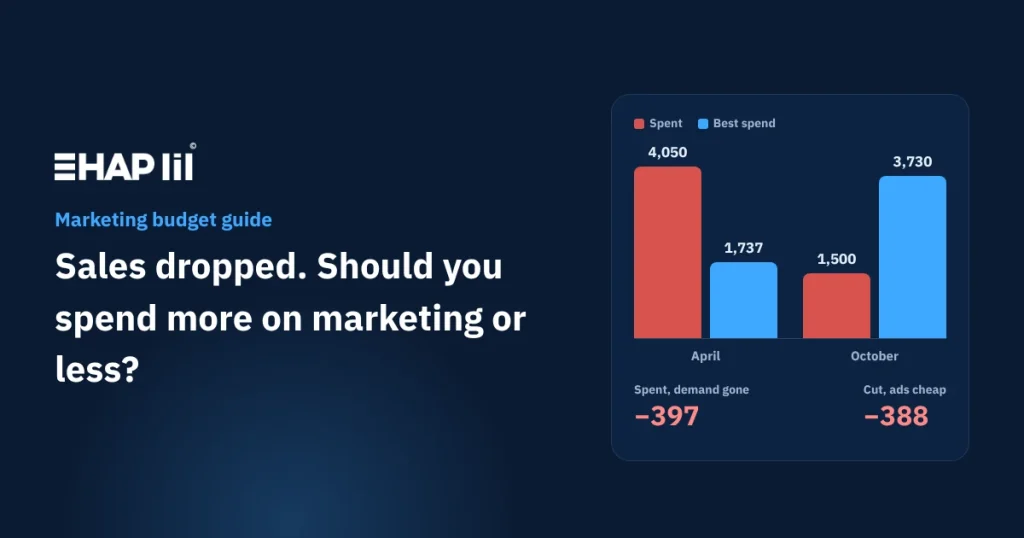
Sales dropped this month. Should you spend more on marketing or less?
It is one of the hardest questions a business owner faces, because both answers sound right
Cut ads and you protect cash, but you may disappear just when your customers are looking for an alternative. Spend more and you may pour money into something that will not come back
This guide gives you one method to answer that question every month. Then we build your marketing budget from your sales goal step by step, with four calculators and a free Google Sheets template
Majed, who runs a perfume store, is an illustrative character from the ehaplil guide series and his numbers come from a method we explain inside the guide. Public figures are published and linked in the text
Should you increase your marketing budget when sales drop?
Sometimes yes, and sometimes it is the worst decision you will make this month
Do not decide from the sales number, decide from the reason it fell. Spend more when demand is still in the market and reaching it got cheaper or a competitor is taking your share. Cut to a floor when demand itself is gone, then spend before it returns
| What happened? | Decision |
|---|---|
| People in the market are searching less | Cut to the floor and save the difference for the weeks before the next season |
| Ads got cheaper or a competitor is taking your customers | Increase in steps as long as the extra customer is profitable |
| Visitors are the same but they do not buy | Fix the store, the price or the sales team before any ad |
One number separates these cases. It is called the extra customer cost and we will get to it shortly
Sales are a lagging number. They are the result of what happened in the market and what you did weeks ago. The decision needs two numbers from the present, how much demand there is now and what it costs to reach it now
Why most people spend at the wrong time
Let us see this in Majed's year
Majed sells perfume online with an average order of 50 dollars. In the ad economics guide we found that the most he can pay in ads for one order is 15.22 dollars, because that is what is left of an order after cost, shipping, payment and returns
In a normal month he spends 3,000 dollars on ads and gets 330 new orders, plus about 270 orders from customers who come back on their own
His budget rule is the most common one. Spend 10% of last month's sales
A budget that follows sales and a budget that leads demand
Majed's year with the same total of 37,350 dollars, once at 10% of last month's sales and once by next month's demand
Bars are Majed's sales in dollars. The red line is the percentage of last month budget and the blue line is the same money split by the following month's demand
The red line rises after sales rise and falls after they fall. Majed's highest budgets came in March and April after the February peak, and in December after the November peak
That made him get it wrong twice in the same year
In April he spent heavily while demand was gone
March was the Eid month with 40,500 dollars in sales, so the rule gave him 4,050 dollars for April. But demand for perfume after Eid dropped 20%
What Majed spent in April
4,050Best spend in a month with 20% less demand
1,737Orders that came from the difference
126Cost of each of those orders, above his 15.22 ceiling
18.37Ad profit lost in one month
−397In October he stopped spending while ads were cheap
In October there was talk of a recession, several competitors paused their ads and the cost per thousand impressions fell 20%, so every dollar bought 25% more reach
Majed's sales dropped only 5% but he got scared and cut ads from 3,000 to 1,500 dollars. The best spend that month was 3,730
Each of the 172 orders that never came would have cost him only 12.97 dollars, under his ceiling. He lost 388 dollars of ad profit and 172 new customers, some of whom would have come back and bought without ads
Ads come before sales and sales come before the budget. If you build the budget on last month's sales, you are driving with your eyes on the rearview mirror
That explains what you see in the market. People spend when sales are good because the rule gives them more money and cash in the bank makes the decision easy. Then they stop when sales drop because ads are the easiest line to cut
What research says about marketing in a recession
Business schools have studied this question for a hundred years. The answer is not always spend more as some write, nor cut it first as most people do
The oldest study
Roland Vaile followed 250 companies through the 1920s recession in Harvard Business Review. Those that raised advertising grew faster than rivals, and those that cut it saw sales fall during the recession and for three years after
4,700 companies in three recessions
Gulati, Nohria and Wohlgezogen found in Harvard Business Review that 17% of companies did not survive and only 9% came out stronger, beating rivals by at least 10% in sales and profit growth
What happens when you go dark?
Brands that stopped advertising lost about 10% of their share after one year and 28% after three, according to Thinkbox, and small brands lost faster than big ones
Coming back is harder than staying
A brand that goes dark loses about 2% of long term revenue every quarter, and recovering what was lost takes 3 to 5 years, according to Nielsen
The most important part of the 4,700 company study is who won. The researchers sorted companies into four groups
The chance of leaving a recession ahead of rivals
Share of companies that pulled ahead after the recession in each group, according to Gulati, Nohria and Wohlgezogen
Companies that spent hard without controlling costs were not the best. The winners cut waste by running operations better and invested in marketing and development at the same time. Target, for example, raised marketing and sales spending 20% in the 2000 recession, and its sales grew 40% and profits 50%
Why do ads get cheaper in a crisis?
Because most competitors cut at the same time, so the same money buys you a bigger share of all the ads in your category. That share is called share of voice (your share of all ads in your category)
Les Binet and Peter Field found in data from thousands of campaigns that brands whose share of voice is higher than their market share tend to grow, and every 10 points of excess is linked to about 0.5% market share growth, according to the American Marketing Association
But the research set conditions
Raji Srinivasan, Arvind Rangaswamy and Gary Lilien surveyed more than 150 marketing executives after the 2001 recession and found, according to Penn State, that going on the offensive in a recession pays off for companies with three things
- Marketing that worked before the crisis, a proven way to turn spend into customers
- A team that moves and tests instead of waiting
- Spare cash, a team with free time or unused capacity
Companies without these resources wait until conditions improve
In the Journal of Marketing, Srinivasan, Lilien and Sridhar analyzed more than 10,000 firm years of US company data across 7 recessions. The effect of advertising changed with market share, debt and type of business, and many consumer service companies overspent
In a study of media plans Nielsen found that 25% of channel spend was above the level that gives the best return, by a median of 32%
The bottom line Companies that win in a crisis do not spend more because sales dropped. They spend more because they have a method they know is profitable and cash that protects them, and they cut waste at the same time
Why did your sales drop? Four causes and a decision for each
Before any budget decision, find where the drop came from, because each cause calls for a completely different decision
| Cause | What you see in the numbers | Where to check | Decision |
|---|---|---|---|
| The market fell | Search for your category fell about as much as your sales | Google Trends and the same month last year | Cut to the floor and spend before demand returns |
| A competitor took share | Search is flat and a competitor shows up more or cuts prices | Auction Insights in Google Ads and the Meta Ad Library | Increase in steps while the extra customer is profitable |
| Ads got cheaper | Cost per thousand impressions or per click fell and demand is flat | Ad dashboards compared with the last two months | The best chance to grow |
| The problem is yours | Visitors are the same and conversion or close rate fell | Conversion rate, stock, price and response speed | Fix first, do not add ads |
There is a fifth cause we see often. Sales did not drop at all, measurement changed, such as a broken tracking tag or a campaign counting orders in a new way. Before you decide, check the number itself, as we do in our measurement and attribution service
Is the drop seasonal?
Compare the month with the same month last year, not with the month before it. If it is 30% below last month but similar to the same month last year, this is a season, not a problem
In our Ramadan demand case study the days of Ramadan were 17% to 44% below normal every year. That was not weakness, demand had arrived weeks earlier
Should you spend more this month?
Answer with what you see in your numbers this month. The decision stops at the first condition that fails
Demand is there, reach is cheaper and every extra customer is under your ceiling. This is the time to grow. Take one step and measure before the next
How much can you pay for one customer?
Every budget decision rests on this number, and most business owners we meet do not know it
Your customer cost ceiling is what is left of a sale before marketing. Pay less than that for the extra customer and you profit. Pay more and you lose
What you keep from a sale is the price after tax, product or service cost, shipping, payment and returns. We worked it out step by step in the pricing and unit economics guide
Majed counts only the first order because his cash is limited and he does not want to wait a year to earn back what he paid, so his ceiling is 15.22. If he counted half his customers buying again within a year, his ceiling would rise to 22.83
Choosing between the two numbers is a cash decision, not a marketing decision. If you have cash to wait, count only the repeat purchases you have actually seen in your sales records, not the ones you expect
Customer cost ceiling
The numbers shown are Majed's. Replace them with yours and the ceiling carries over to the next calculators
If you pay more than 15.22 for the extra customer you lose money on that customer
If you sell through leads, like a services company, multiply the ceiling by your close rate to find the most you can pay per lead. With a ceiling of 600 and 1 in 10 leads buying, the most you can pay per lead is 60
How much more? Judge by the extra customer, not the average
This number is what separated April from October for Majed
The average fools you, because the first customers come cheap from people closest to buying and every dollar after them reaches people further away
In April Majed's average was 12.81 dollars per order, which looks well under his ceiling, but the orders that came from the extra spend cost 18.37 each
We use a rough rule that holds in most small and midsize accounts. Doubling the budget in the same conditions adds about 50% more customers, not 100%. We saw it in the ad economics guide when Majed doubled his budget and orders went from 120 to about 175. In the calculator you can pick 30% if your market is small, or 70% if your market is large and your share of it is small
Cost of the extra order at each spend level
Three months for Majed. The best spend is where each line crosses his 15.22 ceiling
Same store and same ceiling, but the best spend moved from 1,737 in April to 3,730 in October because demand and the cost of reach changed, not because sales changed
How much more exactly?
The numbers shown are Majed's in October. Replace them with yours
Each extra customer costs 12.97, under your ceiling, so the increase pays. Best spend is about 3,712
Seven rules before any increase
- Know the cause before the number. If the problem is yours, extra ads send more people to the same closed door
- Do not buy demand that is gone. If search in the market fell, the increase pays more for the same few people
- Judge by the extra customer, not the month's average
- Do not spend payroll money. We do not raise spend when cash covers less than 3 months of fixed costs
- Never go dark. Keep a floor that covers people searching your name, visitors who did not buy and your current customers
- Increase in steps of 20% to 30% and measure for two weeks before the next one
- Write the stop point before you start, the extra customer cost that sends you one step back
How to build a marketing budget step by step
Do you start with the sales goal, the growth goal or the marketing budget?
You start with the profit you want, then the sales goal that delivers it, then you ask whether the market has room for that goal, then you work out what a customer costs at that volume. The budget comes out at the end
Marketing textbooks call this the objective and task method, a budget built from the goal and the work it takes. It is the opposite of what most people do when they start from the bank balance or a share of last year's sales
The monthly profit you want
After all costs, including your own salary
Sales target
(Fixed costs + profit) ÷ what is left from a sale after its costs
Does the market have room?
How many customers search each month and how many you win now
Returning and new
Subtract the sales that come from customers who return on their own
New customer cost at that volume
Not at your current volume, because cost rises as you grow
Budget and check
Is the last customer under your ceiling and is there enough cash
If you do not have a clear profit goal, start from the sales target that covers your fixed costs and gives you a profit you accept. The calculation is in the free template
Majed's goal for next year
Majed wanted monthly sales to grow from 30,000 to 40,000 dollars, which is 800 orders. 270 of them come from returning customers, so 530 orders must come from ads instead of 330
That needs 6,608 dollars of ads a month at an average of 12.47 per order. That looks fine, but the last orders cost 20.78 each, above his 15.22 ceiling
The goal is right, but ads are not the only way there
If Majed forced ads to hit this goal he would buy growth that loses money on the last orders. This method shows it before you spend a dollar
So Majed changed the numbers that come before ads
- He raised the average order from 50 to 55 dollars with bundles and gifts, so he needs only 727 orders
- He raised repeat orders from 270 to 400 with messages to past customers before each season
Now he needs 327 new orders and an ad budget of 2,959 dollars, and the last order costs 15.07, under his ceiling. Add 1,200 dollars for a designer and tools and the full marketing budget is 4,159 dollars, 10.4% of sales
The same goal with less than half the first budget. The difference came from pricing and current customers, not from ads
Marketing budget from a sales goal
The numbers shown are Majed's before he changed his plan. Replace them with yours
The last customer costs 20.78, above your ceiling. Ads alone reach about 30,112 in profitable sales. The rest must come from sale value, returning customers or a new channel
The same method for any business
| Business | The sale | The new customer | What changes |
|---|---|---|---|
| Online store | Average order | First order from a new customer | Returning customers usually come from store messages and seasons |
| Services company | Average contract | A new contract | Multiply the ceiling by your close rate to find the most you can pay per lead |
| Subscriptions and software | Monthly subscription price | A new paying subscriber | Repeat purchases are the months a subscriber stays within a year |
| Clinic, restaurant or salon | Average bill | A first visit | Repeat visits are usually high, so take them from your booking records |
In the ad economics guide Sara, who runs a services company, needed 90 leads to reach 6 contracts, more than she could afford. When she raised her close rate from 2 to 3 in every 30 by replying the same day, the goal became profitable with only 60 leads. In the media buying guide Khaled found the clinics his goal needed in a niche newsletter at a lower cost than Google
What does a marketing budget cover?
A marketing budget is not only an ad budget. It covers ads, people, tools and content, and inside paid media we split it into three parts
The floor
Search for your name, visitors who did not buy and current customers. It does not drop in any month
Growth
Campaigns where you know the extra customer cost. It rises and falls with demand and cost
Tests
A new channel, message or audience with money you accept losing to learn
What percentage of revenue should go to marketing?
According to the Gartner 2026 CMO Spend Survey marketing budgets were 7.8% of company revenue, up from 7.7% in 2025, with most respondents in North America and Europe. In The CMO Survey for 2026 the average was 9% and the median 5%
Use these numbers to see where you stand, not to set your budget. A large company has returning customers and a known brand, so it needs a lower share than a two year old business, and a percentage does not tell you whether the last dollar is profitable
| Method | How it works | When to use it |
|---|---|---|
| What we can afford | Spend what is left after costs | Only as a cash ceiling |
| Percentage of sales | A share of last month or last year | To compare with the market, not to decide |
| Match competitors | Spend close to what the market spends | To see whether your share of ads is below your share of the market |
| Objective and task | From the goal to customers to cost | This is the method, the other three check it |
A business that wants to grow faster than its market usually spends a higher share in its early years. The right question is not whether your share is high but whether every extra customer costs less than your ceiling
A yearly budget that leads demand, not one that follows it
Customers decide before they buy and search before they decide. If you show up only at the moment of purchase, you compete for the last step against everyone who showed up earlier
In our Ramadan demand case study for a client in the services sector, demand started moving 7 to 9 weeks before Ramadan, peaked 5 to 8 weeks before it, then dropped during Ramadan itself. We moved the plan to spend about 70% of the season budget before it started
Spend where demand will be in a few weeks, not where sales were last month
- Plot two years of weekly sales and mark every season such as Ramadan, the two Eids, National Day, White Friday and back to school
- Find when the rise starts, not when it peaks
- Start spending before the rise by the time your customer needs to decide
- Ease off on days people are busy even if those days are the season in everyone's words
Where does the budget go in a marketing plan?
The budget section of any marketing plan should answer five questions before it states a total
- What is the sales goal and how many new customers does it need
- What is the customer cost ceiling
- What is the floor we never go below
- How much we spend each month by expected demand, not in equal parts
- What is the stop point for each campaign
The 12 month plan tab in the free template spreads your budget by demand and compares it with a share of last month's sales
What to do if your sales are dropping now
This is the plan we follow when a business comes to us with falling sales asking whether to spend more or stop
Free marketing budget template on Google Sheets
Everything in this guide in one file with Majed's numbers. Clear them and type yours. Every cell explains where to find the number
Open the link and it will ask you to copy the file to your account, then type only in the blue cells
Marketing budget template
For stores, services, subscriptions, clinics and restaurants
- Sales target from the profit you want
- Customer cost ceiling
- Budget from the sales goal and the last customer cost
- Should I spend more this month?
- How much more exactly
- A 12 month plan that leads demand
FAQ
How much should I spend on marketing?
Spend what brings the customers your sales goal needs, as long as the last customer costs less than your customer cost ceiling, which is what is left of a sale before marketing. Add fixed marketing costs such as salaries and tools. If the last customer goes above your ceiling, change sale value, returning customers or channels before you raise the budget
What percentage of revenue should go to marketing?
In 2026 it was 7.8% of company revenue according to Gartner, and 9% on average with a 5% median according to The CMO Survey. A small business that wants to grow usually spends a higher share in its early years, but the percentage is only for comparison and the decision comes from the extra customer cost
Should I increase advertising when sales drop?
Increase ads if demand is still in the market and reaching it got cheaper or a competitor took your share, the extra customer cost is below your ceiling and you have cash for at least 3 months. If demand itself fell, or the problem is the store, price or stock, cut to the floor and fix the cause
How do I create a marketing budget?
Start with the profit you want, work out the sales target, subtract sales from returning customers, work out the ad budget that brings the new customers you need, add fixed costs, then check that the last customer is under your ceiling and that cash is enough
Why do sales drop and how do I fix it?
Four main causes, each with its fix. If market demand fell, cut to the floor and spend before it returns. If a competitor took share or ads got cheaper, increase in steps. If the problem is conversion, stock or price, fix it first. If measurement changed, check the number before any decision
How do I know if a sales drop is seasonal?
Compare the month with the same month last year, not with the month before, and check Google Trends for your category. If search fell about as much as your sales, the drop is most likely seasonal
How do I calculate the maximum customer acquisition cost?
Multiply the sale value by the share you keep before marketing, then by one plus the repeat purchases within 12 months. The result is your customer acquisition cost ceiling. If you sell through leads, multiply the ceiling by your close rate to find the most you can pay per lead
What is the extra customer cost?
It is the increase in spend divided by the increase in customers. It matters more than the average because the first customers come cheap and every dollar after them reaches people further from buying. Keep raising spend while it stays below your customer cost ceiling
How do I calculate a sales target?
Add fixed costs and the profit you want and divide by what is left from one sale after all its costs, including marketing. That gives the number of sales you need each month. Multiply it by the sale value to get the sales revenue you need
Does marketing during a recession pay off?
Yes for companies with marketing that works and spare cash, according to studies in Harvard Business Review and from Penn State. Companies that cut waste and invested in marketing at the same time had a 37% chance of pulling ahead after the recession versus 21% for those that cut everything
What happens if I stop advertising?
According to Ehrenberg-Bass, brands that stopped advertising lost about 10% of their share after one year and 28% after three, and small brands lost faster. According to Nielsen recovering what was lost takes 3 to 5 years
Where does the budget go in a marketing plan?
The budget section of a marketing plan states the sales goal, the number of new customers needed, the customer cost ceiling, the floor, the monthly spend by expected demand and the stop point for each campaign, then the total at the end
Before you raise or stop your budget, find out why sales changed
By your numbers the last customer costs 20.78, above your ceiling. Ads alone take you to about 30,112 and the rest of the goal needs another route
In one 60 minute session we review your numbers with you and leave with three written outputs
- Why sales changed, from the numbers and not from a feeling
- A budget from your goal with a ceiling and a floor
- A spend plan for the first 90 days with a stop point for each campaign
Ehap Lil
I help companies reach clear, predictable financial growth by tying marketing effort to financial results, and by fixing the decisions that hold back returns or make sales swing
In this article
Table of contents
Read next

Media Buying Beyond Google, Meta and TikTok: Where Else to Buy Ads

Ad costs: how to calculate ROAS and the maximum cost per order and customer

Pricing and Unit Economics: A Practical Guide for Stores, Services and SaaS

Collections, sales and financing are not separate islands

When should a startup hire a new employee?
